
Dedication
For Poze
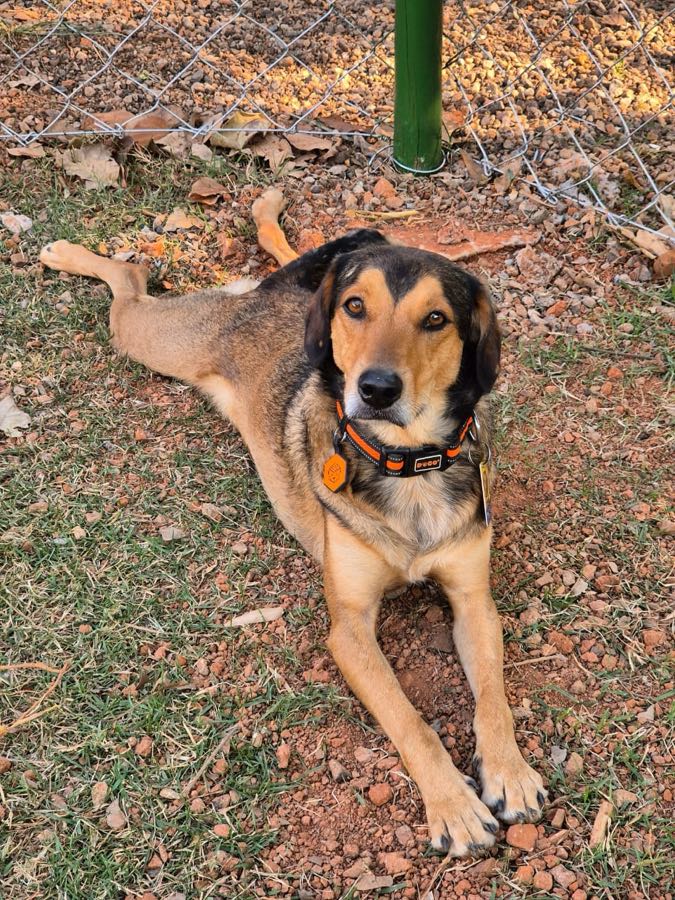
This manual exists because of a much-loved Brazilian dog.
Poze went missing during a trip to Argentina. Giovanni and Amanda, his parents, were tireless in the search, and had the help of the Dogo team throughout.
What is in this book are the same instructions we gave them. We decided to gather them into a manual because no family should have to work all of this out from scratch, on the worst day of their life, with the clock running.
Poze’s family can be followed at @matueofrentista.
That is what Poze leaves to other families: a path already opened. If this book saves someone a single hour — the right hour — it will have done what it set out to do.
From Giovanni, to Poze
To Poze,
I still think about everything that could have been different. But, little by little, I have been trying to think more about everything we lived together. And we lived a lot. Ever since you turned up at my post. Ever since I thought I was the one who had rescued you.
Some things happen that we will never understand. I would give anything to have had more time with you, but I would never trade the time we had just to avoid missing you the way I do today. As much as missing you hurts, it also reminds me that before it there was a life full of love. And how lucky I was to have lived a piece of yours.
Thank you, Poze. I love you, Poze.
— Giovanni
Where part of this book goes
A share of the revenue from this ebook goes to shelters that take in found animals. They are the ones who receive the dog somebody picked up on the roadside and could not identify — and they are where a good many of the late reunions begin.
50% of everything donated goes to shelters that take in found animals.
For Poze. And for every dog still out there, with someone looking.
Keep going with Dogo
If this manual was useful, the work that keeps you from needing it is the everyday kind: reliable recall, reading body language, desensitisation to noise, and safe walking. That is exactly what Dogo does — short, video-guided programmes to do at home.
These programmes are developed with trainers and veterinarians specialising in animal behaviour. Those same people guided the content of this manual — from the temperament reading in Part 1 to the behavioural recovery in Part 10.
Help keep this manual up to date
This manual changes as methods and tools change. If you find something outdated, or you tested a format — a poster, a checklist, a sector map, anything — that worked well in practice and you want to share it as a template for other families, send it our way.
How to use this book
This manual was not written to be read cover to cover. It is a toolbox, not a narrative. Go straight to what your search needs right now, and leave the rest for when — and if — you need it.
- Did it just happen? The first hour
- Is he running from you? Parts 1 and 2
- Do you have people to organise? Parts 4 and 5
- Fearful dog who avoids everyone? Part 8
- Need forms to print? Part 9
- Has it been days already? Part 10
Every chapter opens with a one- or two-line summary, so you can decide in seconds whether that is your chapter right now.
And if you would rather ask than read — which makes complete sense in the middle of a search — the chat in the Dogo app is answered by an AI trained on this same material. Describe your situation and get the guidance for it, without hunting for the chapter. Download the app and start the free trial: the chat is included. dogo.app
Read this first
The first hour
If your dog went missing minutes ago, stop reading the rest of the book and start here. There are eight things, in this order, and none of them requires prior experience.
First, something that usually helps to hear: the fear and the urgency you feel right now are the normal reaction of someone who loves an animal. They do not get in the way of the search. What this chapter does is give them a direction.
- If you can, stop chasing him
If you can still see him, avoid running towards him and avoid shouting. Chasing is anyone's first instinct, and almost everybody does it before they know better — experienced people included. The problem is that a frightened dog reads running as pursuit and moves further away.2 If you already ran, that's fine: what counts is from now on.
- Freeze the point
Go to the exact spot where he was last seen and mark the coordinate on your phone. That is the PLS — Point Last Seen. Everything else in the search is drawn from it. If nobody marked it at the time, no problem: reconstruct it with whoever was there and use the group's best estimate. An approximate point already organises the search.
- Keep it quiet
Nobody shouts his name. Nobody blows a whistle. Calling in chorus is what almost every group does at first, and Part 2 explains why it usually produces the opposite of what you want. Silence also lets you listen: a dog who is trapped or hurt is usually found by ear, not by eye.
- Leave a scent anchor
Bring to the PLS a piece of clothing you have worn all day — the sweatier the better — his bed, and his crate if you have one. Don't put food out yet: in the first hours it draws wildlife that may push your dog away from the spot.
- Leave one person sitting there
One person, sitting on the ground, quiet, for at least an hour — ideally whoever has the strongest bond with the dog. A dog who bolted in a panic will often circle back to the place where he lost his person once he has calmed down, whatever startled him in the first place.
- Make three calls
Municipal shelter or animal control; veterinary clinics within about 30 km (20 miles); and the microchip company, to flag the dog as missing and confirm that your phone number on file is current. Repeat these calls every 24 hours.
- Post one anchor post
One sharp, recent, colour photo showing the dog as he actually looks. Where and when he went missing, your phone number, and the line “do not chase, do not call — phone me”. Hold back one identifying detail for yourself (a scar, a marking, the colour of the collar): it will be your tool against scammers.
- Start writing things down
A notebook or a spreadsheet. Every sighting: time, place, who saw it, which direction the dog was heading, how sure they are. Information becomes the scarcest resource in the operation, and nobody can hold this in their head after a few hours of stress — that is not carelessness, it is how memory works under pressure.
Four things that tend to backfire
Sending dozens of people into the woods shouting his name. It is the most natural reaction in the world, which is exactly why it's worth flagging: it usually scatters the dog further away instead of drawing him in.
Announcing a large cash reward. It attracts scammers13 and sends strangers chasing your dog to “win” the prize, which tends to push him further out.
Driving around with no plan. It feels like doing something, but it covers road rather than terrain, and it burns the first hours.
Only waiting for him to come back at night. Many dogs do come back — and it is still worth working the list above in parallel, because it costs little and widens the odds.
Contents
11 parts · 8 appendicesDo not read this book cover to cover. The First Hour comes before these contents on purpose: someone who has just lost a dog needs it without having to look. After that, go straight to the chapter your search calls for — each one opens with a two-line summary. Part 11 is about grief; if your search is under way, it is not for now.
Part one
The dog you lost is not the dog you know
Before deciding where to look, you need to answer one question: what kind of dog is out there? Not the breed — the mental state. That is what determines how far he travels, who he runs from, and what will bring him in.
1.1Survival mode
In shortA lost dog goes into acute stress and starts acting on survival, not on attachment. Plan for the panicked dog, even if yours is the gentlest in the world.
A dog stops being a domestic animal within minutes of being lost. The unfamiliar environment triggers an acute stress response — cortisol, dilated pupils, fight-or-flight engaged. In that state, his brain prioritises survival over bond. Social recognition moves to the back seat.
From this comes a consequence that is hard to accept: many lost dogs run from their own owners.1 If it happens to you, it is not rejection and it says nothing about the bond between you — in that state, anything approaching quickly reads as a threat. It is a piece of information almost nobody has before they need it.
Rule of thumb
How your dog behaves at home does not predict how he behaves when lost. Plan for the panicked dog even if yours is the gentlest in the world: if he turns out to be calm, you lose almost nothing by being careful; if he is panicking, the care is exactly what makes the difference.
1.2The three profiles, and how far each one travels
In shortGregarious, aloof or fearful — the profile predicts where to look. Gregarious dogs usually turn up within half a mile; fearful ones can cover 2 to 5 miles in the first 24 hours.
Decades of catalogued cases from animal-recovery teams show that lost dogs fall into three broad behavioural patterns, and that the pattern predicts reasonably well where the dog will be found.1 Work out which one describes yours before you draw the map.
| Profile | With strangers | Typical distance | Where to look first |
|---|---|---|---|
| Gregarious | Walks straight up to the first person who calls | Close: about 75% turn up within half a mile | Houses, yards, shops and people around the PLS. The bigger risk is not the woods — it is someone “taking him in” and keeping him. |
| Aloof | Takes food, won't be touched | Long; can stay missing for weeks | Woodland edges, vacant lots, places with accessible food. Solved with a feeding station and a camera, not with volunteers beating the brush. |
| Fearful / panicked | Runs from everyone — including you | 2 to 5 miles in the first 24 hours | Far away, and hidden. Prioritise notices and posters on roads in the area. Instead of calling or following, use passive attraction and a planned capture. |
In the Dogo app
If you are not sure which profile fits your dog, the body-language material in Dogo helps you recognise fear, insecurity and stress before they turn into flight. It is the kind of thing worth knowing before you need it — and it answers the first question of this search.
Dogs who are normally gregarious also fall into the panic profile when the disappearance was traumatic — a crash, fireworks, a thunderstorm, bolting out of a car. The trigger matters as much as the personality.
1.3The six factors that change the distance
In shortTemperament, circumstance, weather, terrain, appearance and population density all adjust the radius. Outside town it needs to be much larger.
Behavioural profile is the main driver, but not the only one. When estimating your search radius, adjust for these six:
- Temperament — the dominant factor, per the table above.
- Circumstance of the loss — did he bolt in fear, chase another animal, fall behind on a trail, or wander off exploring? Each produces a different vector.
- Weather — heavy rain, cold and wind shorten travel and push a dog towards shelter. Fair weather lets him cover more ground.
- Terrain — dense woodland, steep slopes and fencing cut distance sharply; open country and dirt roads multiply it.
- Appearance — a large, thin, collarless dog looks like a stray and gets ignored; a small, clean dog with a collar gets picked up fast. Looking like he belongs to someone shortens the distance travelled.
- Population density — in a city someone intervenes within minutes. In the countryside or the mountains, nobody does. That is why the same breed with the same temperament needs a far larger radius outside town.
1.4How a dog moves through terrain
In shortDogs follow the path of least resistance: trails, roads, woodland edges. They avoid water and thick brush. Mark the funnels — that is where he has to pass.
Dogs do not walk in straight lines and do not pick the hard route. They follow the path of least resistance the great majority of the time.16 That is an enormous advantage for you: it means his movement is predictable from a map.
What he follows
- Trails, dirt roads, firebreaks, power-line cuts, pipelines and dry creek beds.
- Edges — the boundary between woods and pasture, between forest and highway. The strip of low vegetation beside a road is a classic travel corridor.
- Contour lines: in broken country, dogs tend to skirt a slope rather than climb it head-on.
What he avoids
- Water. Most dogs will not cross puddles and creeks — or they look for the narrowest crossing. Mark those pinch points on the map: they are compulsory passages.
- Very dense brush, thorn, exposed rock, very steep ground.
- Fences — which act as walls and can divert a route sideways for miles.
Funnels
Wherever the terrain squeezes — a bridge, a gate, a narrow valley, a culvert under the highway, a stock crossing — the dog has to pass through. These are the best places on the map for a trail camera or a feeding station, because they concentrate probability into a small area.
1.5The dog's clock
In shortHe moves at dawn and dusk and stays put in the heat of the day. Concentrate the search on those two windows.
A lost dog has a routine, and it is not yours. He moves mostly in the late afternoon, at night and before dawn, when it is cool and quiet, and spends the middle of the day lying in shade, motionless. Searching at two in the afternoon on a hot day means searching for a stationary, hidden animal — not impossible, but inefficient.
Two windows are worth more than the rest of the day combined: first light to about two hours after sunrise, and dusk into early night. Those are the travel and drinking hours, and also the quietest, which raises your chance of hearing him.
If you know when he usually drinks at home, use it: dogs keep habits. Water sources near the PLS, watched at those hours, are very high-probability points.
1.6Cold and rain: what changes the urgency
In shortWhat speeds up heat loss is a wet coat, not the cold itself. Prioritise the first rainy nights and the places that offer dry shelter.
A dog's normal temperature runs between 101°F and 102.5°F (38.3–39.2 °C); below roughly 99°F (37.2 °C) he is already hypothermic.15 These numbers are worth knowing not to frighten you, but because they help you decide where to put effort first.
The decisive factor is not cold: it is water. A wet coat loses its ability to insulate and body heat escapes far faster. A dry dog at 40°F (5 °C) is uncomfortable; the same dog soaked, in wind, loses heat much more quickly. Short-coated, thin, very young, elderly and unwell dogs are the most vulnerable.
Food is the smallest worry: a healthy adult dog goes several days without eating. What weighs is water, shelter and temperature. In practice that gives a clear priority — concentrate effort on the first rainy nights and direct resources towards places that offer dry shelter: under banks, inside culverts, beneath buildings, in brush piles, under dense evergreen cover.
If the weather turns
Rain, falling temperature and darkness are a risk to the dog and to the volunteers. Set a hard cut-off time in the briefing, a rally point, and an objective stopping condition — “at six o'clock everyone comes out, rain or not.” That way the team arrives intact tomorrow, which is when it will still be needed.
Part two
Don't call. Don't run. Don't grab.
This is the shortest part of the manual and the most important. If you can only teach your volunteers one thing, teach them this — searches are lost far more often at the moment of contact than while combing the woods.
This is for the fearful, panicked profile
Everything in this part is written for the fearful or panicked dog described in 1.2 — the one who runs from everyone, including you. A gregarious dog, or one who is simply distracted (chasing another animal, exploring, not actually afraid), will often come just fine when called by someone he knows. You know your dog and the situation better than any rule in this book: if calling has been working, keep doing it — it is your call to make. This part exists for when it stops working, or never did.
2.1Why calling his name works against you
In shortCalling his name becomes a flight trigger after a few capture attempts. If he has already run from you, that is probably why — and not something you did wrong.
Everyone's instinct on spotting a lost dog is to call his name and walk towards him. With a dog in a normal state, that works. With a panicked dog, it usually does the opposite.2
Once several people have tried to catch him — neighbours, strangers, well-meaning volunteers — being called becomes a learned trigger: a human voice calling precedes the grab attempt. After a few repetitions, the dog bolts the instant he hears a voice calling. Including yours. If your dog has already run from you after going missing, that is probably what happened — and not something you did wrong.
The same goes for running. Running at a dog is predator language. He does not evaluate your intention; he evaluates the movement.
2.2Calming signals: the sighting protocol
In shortOn sighting: freeze, turn sideways, sit down, look away, toss food. Let him come to you. It can take hours, and the slowness is what makes it work.
If you spot the dog — yours or someone else's — this is the sequence used by animal-recovery teams.2 It is deliberately slow, and the slowness is exactly what makes it work.
- Freeze
Stop where you are. Do not take one more step towards him. If he has already seen you, you have a few seconds before the decision to flee locks in.
- Turn sideways and get small
Never face on, never staring — direct eye contact is a threat. Turn your shoulder to him, sit or lie down. A low, side-on body switches off much of the alarm.
- Look away
Look at the ground or off to the side, with brief occasional glances. Yawn. Breathe slowly and visibly. Dogs read these as “I am not a threat.”
- Toss strong-smelling food on the ground
Hot dogs, chicken, pâté, cheese — the smellier the better. Throw it a few yards from you without looking at him, and keep ignoring him. Then throw some a little closer. And again. You are negotiating distance, not time.
- If you speak, speak low and flat
No name, no commands, no bright excited voice. A bored conversation with yourself beats any calling.
- Let him come. Always him.
It may take minutes or hours. Do not reach out. Do not stand up. Do not try to “seize the moment” when he comes close — that is exactly where most approaches fall apart.
In the Dogo app
Calming signals are canine language, not a training trick. People who have practised reading body language execute this sequence far better under pressure. It is worth sending the Dogo body-language and appeasement-signal material to your volunteers before the briefing — five minutes that change the outcome of an encounter.
2.3He came close. Now what?
In shortDo not grab the collar. Let him touch you several times, or walk him — eating as he goes — into an enclosed space.
When the dog finally comes close and eats near you, there is still a stretch to go. The reflex to reach out and take hold of the collar is almost irresistible — and it is where many approaches come undone in the last second, because the dog learns that coming close ends in capture.3
- Do not grab the collar. Let him touch you first, several times, while he eats.
- If and when he is relaxed and eating beside you, slip a slip lead over his neck in one continuous movement — from below upwards, never over his head from the front.
- Better still: instead of catching him in the open, walk him — eating as he goes — into an enclosed space: a yard, a pen, a shed, a car with the door open, and close the exit.
The rule for volunteers
A volunteer who finds the dog should not try to catch him. They should sit on the ground, stay quiet, send the exact location, phone the coordinator and watch from a distance until the owner arrives. The owner's bond, plus the calm of someone who knows the technique, is worth more than the haste of whoever found him first.
That is why every volunteer carries a lead or rope: not to go catching dogs, but for the unlikely case that the dog walks up to them of his own accord.
2.4The five briefing lines
In shortThe five rules every volunteer has to hear out loud before going into the field.
Before anyone walks into the woods, they need to have heard — out loud, from you — these five lines:
- If you see the dog, do not call his name.
- Do not run towards him, not even to get around him.
- Do not try to catch him. Sit on the ground, side-on, and toss food.
- Send your location and phone the coordinator immediately.
- If he runs, do not follow — write down the direction and the time. That information is worth more than the chase.
Part three
The alert network
Most lost dogs are not found by the people searching. They are found by a stranger who ran into the animal and knew what to do. Your job in the first 24 hours is to make sure as many strangers as possible know — and know the right thing.
3.1Anchoring the point
In shortFix PLS, LKP and IPP as coordinates, not descriptions. Without a centre there is no radius, and without a radius there is no plan.
Rescue teams do not say “he went missing somewhere over there.” They fix three points, because each answers a different question:
- PLS Point Last Seen — where a reliable witness last saw the dog, with a time.
- LKP Last Known Point — the last confirmed trace: a track, a camera hit, a GPS ping. It can be more recent and further away than the PLS.
- IPP Initial Planning Point — the point you choose as the centre of the map. Normally the LKP if it is reliable; otherwise the PLS.
Write down coordinates, not descriptions. “Near the gate by the farm” means five different things to five people, and three days later nobody remembers which gate it was.
3.2The call list
In shortShelters within 20 miles, vets, the microchip registry, highway services and delivery drivers. Redo it every 24 hours and go in person when you can.
Make all of them, and make them again every 24 hours.6 Intake systems get overwhelmed and phone descriptions fail — whenever you can, go in person and look at the animals with your own eyes.
- Animal control, municipal shelters and humane societies — all of them within at least 20 miles, not just your own town. A dog lost in town A gets picked up in town B.
- Veterinary clinics and pet shops. The front desk is where people mention an injured stray, a found dog, an unfamiliar dog turning up.
- Local rescue groups and independent fosterers — usually the fastest information network that exists locally.
- The microchip company: flag the dog as missing and confirm today that the number on file is yours.
- Highway maintenance and whoever collects animals struck on the road.
- Postal workers, delivery drivers, school-bus and van drivers, refuse collectors. These people cover far more ground every day than any volunteer of yours.
3.3Rural ground: who actually knows those woods
In shortSmallholders, herders and hunters cover ground daily that your team would need weeks to sweep — and they read sign that volunteers cannot see.
Outside town the network changes completely — and improves, if you know who to talk to. Smallholders, ranch hands, shepherds, loggers and tractor drivers move daily through areas your team would take a week to cover, and they notice what is out of place in a landscape they know by heart.
Tell the hunters — for both reasons
If there is hunting in the area, contacting local hunting associations and groups is one of the most useful things you can do, for two independent reasons:
- Safety. A loose dog in the woods can be mistaken for game, or for a feral dog worrying livestock. Telling people reduces that risk concretely.
- Competence. Hunters are specialists at reading sign: tracks, scat, hair caught on wire, flattened vegetation, direction of travel. It is precisely the skill your search needs and that most volunteers lack.
Talk to anyone running cattle or sheep, too. They need to know there is a lost dog in the area before they draw their own conclusions about an unfamiliar dog near the herd.
3.4Posters that work
In shortFive seconds of reading: big headline, real photo, phone number and “do not chase”. No filter, no retouching, no AI-generated image.
A poster is read in five seconds, often by someone in a moving car.17 Anything that does not fit into those five seconds is wasted paper.
What goes on
- “LOST DOG” in capitals, sans-serif, taking up about a quarter of the sheet.
- One photo — recent, colour, sharp, full body, showing the dog as he actually looks. Not the cute birthday shot; the one that lets someone recognise him.
- Phone number in large digits, legible from a distance.
- Where and when he went missing.
- “DO NOT CHASE — CALL”. This line saves miles.
What stays off
Backstory, paragraphs, emotional appeals, a list of characteristics, the reward amount in large type. Two or three colours at most — red, orange and yellow read as urgent. Print big and laminate it, or put it in a clear plastic sleeve: a poster blurred by rain stops communicating, and its place on the pole is taken.
Don't let the poster look AI-made
It is very easy now to generate an illustrated portrait of your dog, a polished layout or a well-written emotional caption. It is worth resisting, for two reasons.
The first is practical. Whoever might recognise your dog needs to match the poster against the animal they saw in the street. Illustration, filters, swapped backgrounds, cut-outs and retouching interfere with exactly that comparison — and recognition is the image's only job.
The second is about attention. The look of AI-generated content has become recognisable and it is everywhere, and people have trained their eyes to treat it as advertising. A poster that looks like an ad gets skipped at precisely the moment you need someone to stop and look.
A real photo taken on your phone — crooked, badly framed, whatever — communicates that this is urgent and true. That is what makes someone stop. The same applies to your social posts: plain, direct text written by you outperforms polished copy.
Where to put them
At eye level, at junctions, neighbourhood entrances, petrol stations, corner shops, vets, schools, bus stops and building entrances. In rural areas: gates, feed and farm-supply stores, co-ops, tyre shops, roadside services and churches. Check local rules on fixing notices to poles before you start.
Two channels the city forgot
Churches. Ask the priest or pastor to announce it at the end of the service. In small towns and rural areas this is the highest-reach communication channel that actually exists, and it is free.
Local radio. AM and community stations reach people who are driving, working the land and listening at home — exactly the people who might cross paths with your dog.
3.5Online: the right reach, not the big reach
In shortRight reach beats big reach. And delegate: this is the part of the search that hands over best to people who cannot be in the field.
A normal post reaches your friends — who mostly live far from where your dog is walking. The person who will find your dog is a stranger within a few miles of the PLS. All of your digital work consists of correcting that mismatch.
You do not have to do this part yourself
Everything in this section is phone work — and phone work is the part of a search that delegates best. You are usually more useful in the field, where you know the dog, the ground and the people. Being stuck to a phone answering messages is a bad trade.
Think about the people who love you and your dog but cannot come out: those who live far away, those with mobility limitations, those who cannot take time off work, those with a small child, those who could not manage eight hours of walking. Those people often feel useless at a time like this — and they are exactly the right ones for this job. Sweeping groups, posting every day, answering messages and filtering leads is real, important work, and it can be done from anywhere in the world, at any hour.
How to set it up: two or three people, each taking a shift of the day. They work the groups, post, reply, check “found dog” and rehoming ads — and pass on to you only what is actionable: a sighting with a time and a place. They absorb everything else, including the messages that only hurt.
- Local lost-and-found groups on Facebook — your town's and the neighbouring towns', plus neighbourhood, hiking, fishing and hunting groups for the area. There are usually dozens, and it is worth joining all of them.→ triage team: join, post and revisit daily
- WhatsApp groups — building, street, rural community, residents' association, school, church. Smaller reach than Facebook, but almost everyone reads them.→ ask a family member who is already in those groups
- Geo-targeted boosting. Pay to show the post to people within a radius of the PLS — typically 1 to 10 miles depending on density. It is cheap, and it is the difference between talking to your friends and talking to your dog's neighbours.12 Targeting by interest in animals raises relevance. Google ads do a similar job for people searching “found dog” plus your town's name.→ hand this to whoever is most comfortable with ads
- Stories with a location tag, asking for reshares from people who live in the area.→ anyone with a large local following
- Post every single day. A post's reach and people's memory decay at the same speed.→ the easiest task to forget mid-search, and the easiest to delegate
If you have a following, an audience or a large network, that network is a resource — but running it is a full-time job, and it is not your job this week. Hand it to someone who wants to help and cannot be in the woods.
3.6Scammers
In shortHold back one identifying detail as your verification tool. No real shelter charges a ransom over the phone.
Posts about missing animals get swept by scammers precisely because they advertise a desperate person with money available. The standard scam: someone calls saying they have your dog, often “injured”, and asks for money up front for care, transport or “rescue”. Variants impersonate a shelter or a veterinary clinic.13
Warning signs
- A request for payment up front, especially by instant transfer, gift card or peer-to-peer app.
- Refusal or excuses for not sending a current photo (“no signal”, “my phone has no camera”).
- Haste and emotional pressure; pushing to move the conversation off the platform.
- Details that match exactly what you posted — and nothing beyond it.
How to verify
- Hold one detail back. When you post, deliberately leave out one characteristic: a scar, a marking on his belly, the exact collar colour, a quirk. Ask the caller for that detail. It is your best verification tool.
- Ask for a photo now, holding any random object, or a short video. Someone who really has the dog can do it.
- If they claim to be a shelter or a clinic, hang up and call back using the number on the official website, never the one the caller gave you.
- Never go alone to a meeting. Public place, busy, with company.
Remember
A real shelter does not charge a ransom over the phone and does not hold an animal hostage. No advance payment is ever required for you to get your dog back.
Part four
Setting up the operation
From the second day on, or as soon as more than five people are involved, searching stops being an effort and becomes an operation. Search-and-rescue teams have been running operations for decades on the same six-step cycle. It works just as well for a dog.
4.1The six-step cycle
In shortSize-up, contingencies, objectives and map, resources, prepare, act — then back to the start each shift, with whatever is new.
It is not a list you complete once. It is a cycle: when the last stage ends, or when new information appears, you return to the beginning. In practice it runs every shift — morning and late afternoon.
Where this method comes from
This is not a scheme invented for dogs. It is the response cycle used and recommended by search-and-rescue organisations that look for missing people — among them Tayside & Central Scotland Search and Rescue, whose public material on the six-step process is the basis for this part,7 alongside the search-management manuals of SARBC.10
What Dogo did was adapt it to canine behaviour: swap the human subject profile for the three profiles in Part 1, replace witness interviewing with reading temperament and triggers, and add the fronts that only exist when the subject is an animal — passive attraction, feeding stations, humane capture and scent dogs. The decision structure is the same one that saves people; the content of each step is canine.
- Size-up
Who the dog is, what happened, what the environment is doing. This is where the search finds its direction.
- Contingencies
What can go wrong in the next few hours, and what you do when it does.
- Objectives and map
What success means for this shift, and which sectors you will spend it on.
- Resources
Who is available, with what skill and what equipment.
- Prepare
Command post, briefing, control of who goes in and who comes out.
- Action
Containment, hasty search, systematic sweep, passive attraction. Then back to step one.
4.2Size-up: the questions that open the search
In shortThe questions about the dog, the event and the environment that determine where to look. Finish by asking: if I were him, where would I have gone?
Answer these in writing, with the team together. The answers become the dog profile (Appendix D) and the basis for every decision that follows.
About the dog
- Is he fearful, gregarious or aloof with strangers? How does he react to loud noise, to unfamiliar people, to other dogs?
- Age, size, physical condition. Does he normally manage 2 miles or 10? Is he active or lazy?
- Health problems, medication, sight, hearing.
- Has he ever lived rough? Has he been lost before? Has he ever slept outside?
- Neutered? A female in heat completely changes the range and the behaviour — hers and that of the local dogs.
- What attracts this dog? Other dogs, livestock, people with food, water, game, rubbish, motorbikes? The answer points to concrete destinations on the map.
About what happened
- Exact time, exact place, who was there.
- What he was doing the moment he disappeared, and which way he went.
- What triggered the flight — a fright, a chase, a scent, another animal, an open gate?
- Was he wearing a collar? A tag? A tracker?
- Where you have walked with him before — known trails, the route you took on arrival. Dogs return to routes they already know.
About the environment
- Current temperature and the forecast for the next 48 hours. Is rain coming? Will it drop near freezing overnight?
- How many hours of daylight are left today.
- Terrain type, vegetation density, relief.
- Where the water is. Springs, creeks, stock troughs, ponds.
- Hazards: highways, railway, cliffs, dangerous wildlife, hunting in the area, farm dogs, traps, electric fencing.
- Who lives or works inside the radius.
Think like him
Once everything is answered, ask the final question out loud with the team: “if I were this dog, frightened, hungry and cold, where would I have gone?” Write down the three strongest answers. Those are your hypotheses, and they are what the map gets prioritised around.
4.3Contingencies
In shortDecide in advance: weather turning, comms failure, medical emergency, a volunteer lost, the dog sighted.
Five minutes deciding this beforehand prevents two hours of chaos later.
- Weather turning. Which condition pulls everyone out of the field, and who gives the order.
- Comms failure. Much of the area probably has no signal. Set a backup channel, a fixed rally point and time, and one simple rule: anyone who cannot get through returns to the point at the agreed time.
- Medical emergency. Where the first-aid kit is, who has a vehicle, the route out and the nearest hospital.
- A volunteer lost. This is why nobody goes in alone and everybody carries a whistle.
- Dog sighted. Who gets called, who moves, who stays watching from a distance — decided beforehand, not in the moment.
- If he is found needing care. Which vet is on call, who transports, who has a blanket and a crate. If he is trapped or somewhere hard to reach, the numbers for the fire and rescue service and for the regional animal-rescue group need to be written down before they are needed (section 5.6).
4.4Objectives and map
In shortA circle centred on the IPP, divided into slices, one per pair. Best resources on the strongest hypothesis, without zeroing out the others.
The objective of a shift is not “find the dog.” It is something verifiable: cover sectors A, B and C; install two feeding stations at the funnels; confirm or rule out the old-road hypothesis. Verifiable objectives let you know, at the end of the day, whether the day produced anything.
The map is always drawn the same way: a circle centred on the IPP, divided into slices, with distance rings.10 Each slice goes to a pair. The slices are not worth the same — and that is what separates an organised search from a group walk.
Prioritise without abandoning
Rank your hypotheses from most to least likely and put your best resources on the strongest slice — the most experienced people, the scent dog, the thermal drone, the most hours. But do not zero out the others: thin coverage across five slices is worth more than no coverage across four, because ruling terrain out is also progress. A sector confirmed empty is information that shrinks the problem.
Record the coverage
Every sector has a state: not covered, partial or covered. Without that record, by day four you will be sweeping the same easy strip near the road for the third time while the bottom of the valley has never been visited. Mark the blind spots too: marsh, banks, impenetrable brush, locked property — they come back in Part 10.
4.5Resources: not every volunteer is right for everything
In shortSort people by skill and never let anyone go in alone. The command post is the most underrated role in the operation.
Sorting people by skill is not fussiness: it stops someone unprepared from becoming the next emergency. Split into explicit roles:
- Bush-wise — people who know that ground and can read sign. They go to the priority sector.
- Walkers — good fitness, able to manage eight hours. Systematic sweeping.
- Drivers — high-clearance vehicle or motorbike, for roads, funnels and restocking water and food at the stations.
- Operators — whoever has a drone, trail cameras, radios.
- Command post — someone who stays with the map, answers the phone and records. It is the most underrated role and one of the most decisive.
- Digital triage — remote, handling groups, posts and messages (section 3.5). It is the right role for people who badly want to help and cannot come out, and it drops off the list precisely because it does not happen at the search site.
Always in pairs
Nobody goes into the woods alone, no exceptions. Pairs keep each other safe, hold the line spacing and check each other's work. Where possible, build mixed pairs with complementary profiles — someone who knows the ground with someone who has the legs, someone experienced with someone new.
4.6Prepare: the command post
In shortOne fixed point with the map, the central phone and the sign-in/sign-out sheet. Briefing at the start, debrief at the end.
Pick a fixed point — a porch, a shed, the bonnet of a pickup — and do not move it. That is where the big map lives, along with the sector list and their states, the central phone number printed on the posters, the sightings log, water and food.
Keep sign-in and sign-out control: name, phone, sector, time in and expected time back. Nobody enters without signing in and nobody leaves without saying so. That is how you find out in minutes, rather than hours, that someone has not come back.
Run a group briefing at the start of every shift (script in Appendix C) and a short debrief at the end: each pair reports what they covered, what they saw and what they could not do. Five minutes of debrief stops the most valuable information of the day dying in the exhaustion of the people who came back.
4.7Action: three fronts at once
In shortContain the edges, run hasty searches on the strong hypotheses, sweep systematically — with passive attraction running the whole time.
1 · Containment
Before combing the interior, deal with the edges. Identify how the dog would leave the area — highways, bridges, gates, valley heads — and treat those points as priority: posters, notices to residents on the boundary, cameras at the funnels. Containing the area is what stops all of today's work being undone by a ten-mile move overnight.
2 · Hasty search
Pairs working trails, roads, woodland edges and watercourses in the direction of the strongest hypotheses. Low coverage, high speed — and the best return per hour in the first 48. Start from the PLS, one pair in each direction; each pair records the track on a phone so everyone knows exactly what was walked.
3 · Systematic sweep
The line of volunteers covering a whole sector, described in Part 5. Slow, expensive in people and hours, but it is what actually closes a sector.
And running in parallel from day one, passive attraction: scent and feeding stations, cameras, monitoring (Part 8). It is the front that works while everyone sleeps — and with fearful dogs, it is the one that most often resolves the case.
Part five
Searching on foot
People walking through the woods are the most abundant resource in any search and the most poorly used. Twenty people spread at random cover less useful ground than six people in a well-spaced line — and leave a trail of scent and noise that gets in the way of the other fronts.
5.1The volunteer kit
In shortTwelve mandatory items. Send the list ahead and check it at the briefing; don't rely on “I'll bring it”.
Nobody goes into the field without these. Send the list in writing beforehand and check it at the briefing.
- Water and food for the whole shiftMore than you think you need. Dehydration takes down attention before it takes down the body.
- A whistleOr a can with stones in it. It is the volunteer's own distress call — three blasts. It is not for calling the dog.
- Rain gearAnd a dry change in the car. A soaked volunteer in the cold becomes an emergency.
- An item carrying the family's scentA shirt worn all day, to rub on trees and rocks along the route (section 5.5).
- Charged phone and a power bankTo record the track walked, pick up a tracker signal and reach the command post.
- Tape, string or bright paintTo mark trees, delimit what has been covered and avoid getting lost.
- A lead, collar or ropeOnly in case he comes of his own accord. It is not permission to try a capture.
- A torch, ideally a headlampKept pointed at the ground — a bright light in a frightened dog's face makes him run and destroys your own night vision.
- Protective clothingLong trousers, long sleeves, closed boots. Bright colour or a hi-vis vest, especially where there is hunting.
- Strong-smelling treatsHot dogs, chicken, pâté. In a sealed bag, in case of a sighting.
- Offline map and basic first aidPhone signal will fail. Download the map before you leave.
- Posters and tapeTo put up along the way, at gates, shops and junctions.
5.2The sweep line
In shortSpace by the neighbour rule: if you cannot see the feet of the person beside you, there is a blind strip between you. At night, halve it.
Line searching is the standard ground-search method:8 volunteers advance side by side, holding constant spacing, each responsible for the strip in front of them. The whole line moves together, at the pace of the slowest.
How to choose the spacing
There is no universal number: the right spacing depends entirely on vegetation, relief and light. Use this rule of thumb, which needs no arithmetic:
The neighbour rule
Each person should be able to see the ground at least halfway to their neighbour on each side. If you cannot see the feet of the person beside you, the line is too wide and there is a blind strip between you.
In practice that usually means a few yards in dense woodland, scrub or bamboo, and a few dozen in pasture and open country. At night or in fog, detection range collapses — ground-search studies show effective sweep width falling to a fraction of the daytime figure.9 If you are going to sweep in the dark, halve the spacing or less, or accept that it is an exploratory pass and not coverage.
Serpentine within the sector
The line enters at the sector edge and works in a zigzag: across from one side of the slice to the other, advance a stretch, back again. That covers the whole slice without repeating and without leaving gaps — the pattern drawn inside sector A in Part 4.
Listening stops
Every 15 or 20 minutes, the whole line stops. Total silence for sixty seconds. Everybody listens. A dog caught in a fence, fallen into a ditch or hurt is found by ear long before he is found by eye — and the noise of ten people walking makes that impossible.
Finally: slow beats wide. Covering a sector twice at 60% quality is not the same as covering it once properly — the misses tend to repeat in the same difficult places. Prefer less ground, well swept.
5.3Marking what has been covered
In shortTape on the ground and a recorded track on the phone, always both. The gaps between the recorded lines are tomorrow's task list.
By day three, nobody remembers exactly where they walked — that is true of any team, however dedicated. Without marking, it is easy to repeat the strip near the road and never reach the bottom of the valley. Mark in two ways, always both.
On the ground
Bright flagging tape — orange or pink — string or masking tape, tied to branches at eye level. Agree a simple code with the whole team before you start. For example:
- One colour for the limit of swept area.
- Another colour for a point of interest — sign found, track, flattened vegetation.
- A third for hazard, or a blind spot not searched.
Write on the tape when you can: date and initials. Collect the tape at the end of the operation — the woods are not a bin.
On the map
Every pair records the track on a phone with any GPS tracking app. At the end of the day, overlay all the tracks on the command-post map. The gaps between the recorded lines are exactly your task list for tomorrow. That overlay is the most valuable information a search produces, and it disappears if nobody records.
5.4Reading the ground
In shortSix signs any volunteer learns in minutes: flattened vegetation, bent branches, hair, tracks, fresh scat and the behaviour of other animals.
Hunters and trackers call sign the set of traces an animal leaves. The basics are quick to learn, and they multiply the value of every hour your team spends in the field. Teach these six at the briefing:
- Flattened vegetation. Grass, fern or foliage pressed into an oval shows where an animal lay down. Compare the size of the “bed” with your dog's build.
- Direction in the brush. Thin branches bent or broken point the way something passed. Several in the same direction form a corridor.
- Hair. Caught on barbed wire, thorn, fencing or rough bark — look at the height of your dog's back, and at places he would have gone under something.
- Tracks. Only appear in soft ground: mud, creek-side sand, dust on a dirt road, flower beds. Photograph with an object beside them for scale.
- Scat. Fresh scat is glossy and moist; that means hours, not days. It is one of the most useful indicators that the dog was recently there.
- Other animals' behaviour. Most of the time it has nothing to do with your dog, but it is worth checking: agitated livestock, farm dogs barking at night always towards the same direction, or birds circling insistently over one spot.
When you find sign
Do not touch it, do not tread around it. Mark with tape, photograph, record the coordinate and the time, and tell the command post. A confirmed sign is a new LKP — and it can redraw the entire map, shifting the centre of the search.
5.5The scent trail
In shortRub a family garment every 100–200 yards, always converging on the same point.
As they walk, each volunteer builds a scent corridor that can bring the dog back on his own. It is passive work, costs nothing, and keeps working after everyone has gone home.
- Every hundred yards or so, rub the family garment on a trunk, a fence post or a rock, at the height of a dog's nose.
- Make the corridors converge — all pointing towards the PLS, the base camp or the feeding station. A scent that leads nowhere does not help.
- Leave strong anchors at the convergence point: the dog's bed, his crate, worn clothing and — yes — his own faeces, if you have access to them. They are the most recognisable smells that exist to him.
5.6Volunteer safety
In shortNobody alone, a fixed cut-off time, a whistle for everyone. If the situation needs skills you don't have, stop and call people who do.
The aim is that everyone comes back — including the people doing the searching. These rules are not negotiable:
- Nobody goes in alone. Nobody goes in without signing in and out.
- A fixed cut-off time, announced at the briefing. When it comes, everyone comes out — including whoever was “almost there”.
- A whistle for everyone. Three blasts means help, and everyone needs to know that before going in.
- Torch pointed down, always.
- Never enter private property without speaking to the owner first. Besides being right, it turns the landowner into an ally with a hundred acres of local knowledge.
- Watch for snakes, insects, farm dogs, electric fences, wells, banks and unstable ground.
- Exhausted people see less, and the sector ends up recorded as covered when it wasn't. Resting is part of the work, not the abandonment of it.
Know where your capability ends
Looking for a dog does not justify an improvised rescue. If at any point the situation demands technique you do not have — height, ropes, water, unstable slope, confined space, a structure at risk, or an animal trapped and hurt somewhere hard to reach — stop and call people with the equipment and the training.
It is common for the urge to reach an animal you can already see to push someone into improvising with whatever is to hand. That is exactly the moment to stop. Waiting two hours for a prepared team beats turning one search into two incidents.
Call your local emergency number and ask for fire and rescue; they handle technical rescue, including of animals. Many regions also have specialist volunteer animal-rescue groups — in Brazil, for instance, GRAD Brasil, made up of vets, biologists and firefighters and active across many states. Look for the equivalent where you are before improvising.
The same applies to you: if the search is beyond your skills or your team's, asking for help is not giving up — it is the right call.
Part six
Technology
Trackers, drones and trail cameras do solve cases — but only inside fairly narrow physical limits, and almost all frustration with this equipment comes from using it outside them. This part is about where each one actually works.
6.1AirTag or GPS collar?
In shortAn AirTag is not a GPS and does not work where nobody walks past. Outside town a cellular collar is the minimum; with no coverage, only radio works.
The most expensive confusion about dog tracking is thinking an AirTag is a GPS. It is not. An AirTag does not know where it is: it emits a very short-range Bluetooth signal and depends on a stranger's phone passing nearby to relay the position. In a city full of phones that works very well and costs little. On a mountain, on a farm or on a back road, nobody passes — and the AirTag stays silent.
| Technology | How it gets a position | Works well | Fails |
|---|---|---|---|
| Bluetooth tag (AirTag and similar) |
No GPS. Depends on strangers' phones passing nearby. | City, busy neighbourhood, apartment block, shopping centre. | Countryside, mountains, woodland, small hours — anywhere without people moving about. |
| GPS collar with SIM (4G/LTE) |
Real GPS; sends the position over the mobile network. | Anywhere with cellular coverage, even weak. Covers most roads and inhabited areas. | Valleys, deep woodland and areas with no coverage — it stops updating exactly where you need it most. |
| Radio tracker (LoRa / VHF, with handset) |
GPS plus a direct radio link to a handset you carry, no carrier involved. | Off grid: mountains, forest, open country. Range of miles in open terrain. | More expensive and heavier; range drops sharply with relief and dense vegetation. |
| Hunting tracker (e.g. Garmin Astro/Alpha) |
Long-range radio with topographic mapping on the handset. | Built exactly for a loose dog in woodland with no signal; tracks several dogs. | Expensive; collar too bulky for small and medium dogs. |
For your situationIn an urban area, a Bluetooth tag already covers most cases — it is the cheapest, fastest option to set up today.
For your situationIn a rural or wooded area, skip straight to a GPS collar with a cellular SIM — a Bluetooth tag will not work out there.
What to choose
City: a Bluetooth tag solves most cases and costs little.
Trails, camping, farms, mountains, hunting: a GPS collar with a SIM is the minimum. If the area has no coverage, only a radio tracker genuinely serves.
In any scenario: a physical tag with a phone number and an up-to-date microchip are still what brings most dogs home. And a flat tracker is an ornament — check the battery before every trip.
6.2Drones: where they help and where they don't
In shortA normal drone is nearly useless over dense woodland and excellent in open country. Thermal is what changes the game — inside a narrow window of conditions.
An ordinary drone with a colour camera, over dense woodland, is close to useless. The canopy hides everything underneath, and you will spend battery filming the roof of a forest. It is excellent at something else: open country, pasture, burned ground, quarries, riverbanks, sand, low crops and roadsides — places where a dark body on light ground jumps out.
The thermal drone is what changes the game — but inside a narrow window of conditions, and with an altitude rule that almost every beginner pilot breaks.
For your situationWorth prioritising: in wooded terrain with few people around, a thermal drone can cover in one afternoon what would take days on foot.
6.3The calculation that decides whether you will see your dog
In shortThe ten-pixel rule: below that the dog is a smudge. With a common thermal sensor, 130 ft for a small dog and 165–200 ft for a large one.
Search pilots work with a measure called GSD — ground sample distance, or how many centimetres of terrain fit inside a single pixel of the image. It answers the question that matters: how many pixels is my dog made of at this altitude?
The ten-pixel rule
Below roughly ten pixels in length, a target stops being recognisable — it becomes a smudge indistinguishable from a sun-warmed rock or a bush. Flying higher is tempting because it covers more ground per pass, but the extra ground is worth nothing if the target has become three pixels.
The table below is for a DJI Mavic 3T, one of the most widely used models in search work. Its thermal sensor is 640 × 512 pixels. The last two columns show how many pixels a dog is made of at each altitude.
| Altitude | GSD | Ground footprint | Area/frame | Dog 20 in | Dog 40 in | Verdict |
|---|---|---|---|---|---|---|
| 40 m · 130 ft | 5.27 cm/px | 36.8 × 29.4 m | 1,083 m² | 9.5 px | 19 px | Working altitude. Small dog at the limit, large dog comfortable. |
| 60 m · 200 ft | 7.91 cm/px | 55.2 × 44.2 m | 2,437 m² | 6.3 px | 12.6 px | Large dogs only. No longer reliable for a small dog. |
| 100 m · 330 ft | 13.19 cm/px | 92.0 × 73.6 m | 6,770 m² | 3.8 px | 7.6 px | Insufficient at any size. |
| 120 m · 400 ft | 15.82 cm/px | 110.4 × 88.3 m | 9,749 m² | 3.2 px | 6.3 px | At this altitude the dog does not appear in the image. |
This is why experienced animal-search pilots work at around 40 m (130 ft) for small dogs and 50 to 60 m (165–200 ft) for large ones with this equipment — the range given by Gediminas Gerulaitis from real forest searches for dogs. The 120 m / 400 ft ceiling that regulations in many countries allow is, for this purpose, not usable.
To work it out with your own equipment
Two calculations, in this order:
- GSD = ground footprint width (in cm) ÷ image width (in pixels).
- Pixels of dog = dog's body length (in cm) ÷ GSD.
If the result comes out below ten, descend. The ground footprint at each altitude is usually in the drone's manual, or can be measured in practice by putting an object of known size on the ground.
| Altitude | Wide · footprint | GSD (48 MP) | Tele · footprint | GSD (12 MP) |
|---|---|---|---|---|
| 40 m | 57.6 × 43.2 m | 0.74 cm/px | 8.4 × 6.3 m | 0.22 cm/px |
| 60 m | 86.4 × 64.8 m | 1.12 cm/px | 12.6 × 9.5 m | 0.33 cm/px |
| 100 m | 144.1 × 108.0 m | 1.86 cm/px | 21.1 × 15.8 m | 0.56 cm/px |
| 120 m | 172.9 × 129.7 m | 2.23 cm/px | 25.3 × 19.0 m | 0.67 cm/px |
Note the difference in scale: the colour camera has resolution to spare even at 120 m — its problem was never the pixel, it was the canopy. The thermal sensor sees through shade and darkness, but at a thirtieth of the resolution. Each solves half the problem.
6.4The thermal window
In shortThermal sees difference in heat, not heat. Pre-dawn, first light, overcast days and night. With sun on the woods, flying does not help.
A thermal camera does not see heat — it sees difference in heat.11 It works while the dog's body is clearly warmer than the ground, the rocks and the leaves around him. As soon as the sun warms the forest, that contrast disappears and the image turns into uniform soup.
When to fly
- Pre-dawn and first light — the best window of the day. The ground has spent all night losing heat.
- Overcast days — cloud prevents solar heating and keeps contrast high all day.
- Full dark — thermal works the same in total darkness, often better than by day. But see the caveat below.
- Cold season — from autumn to early spring contrast is naturally higher. Summer with a dense canopy is the worst possible case.
When it is not worth it
High sun, hot afternoon, warmed rock and asphalt, closed tropical canopy. In those conditions the equipment is not faulty — physics is simply not on your side. Save the battery for the next window.
Without a spotlight, every target becomes a run
The thermal sensor will flag dozens of warm blobs per flight, and the overwhelming majority will be deer, foxes, livestock, or a termite mound in the sun. If the drone has no spotlight to identify the target from the air, someone has to walk out and check each one in the dark. Plan for that time — or prioritise overcast daytime flights, where the colour camera confirms the target on the spot.
6.5Flight pattern
In shortZigzag with overlap calculated from the ground footprint. Log the area flown — it is coverage like any other.
- Fly a zigzag over the area, holding constant altitude and low speed. It is the same logic as the volunteer line, seen from above.
- Overlap the passes. Use the ground footprint to work it out: if at 40 m the thermal image covers 36.8 m of width, the flight lines should be 25 to 30 m apart, not 40 — otherwise a blind strip is left between them, exactly as between two volunteers spaced too far apart.
- Split the work by terrain: colour camera over open ground, thermal over woodland.
- Prioritise clearings, woodland edges, trails, firebreaks and water margins — the places where the canopy does not block the view and where the dog actually moves.
- Log the area flown on the command-post map. Flight is coverage like any other, and badly logged coverage gets re-flown.
- Record every unconfirmed thermal target as a ground task, with coordinate and time.
6.6Trail cameras
In shortLow (12–24 in), at 45°, set back from the bait. At the map's funnels and on every feeding station.
These are the most underrated resource in a long search: cheap, silent, and working 24 hours a day without frightening anything. With fearful dogs, it is often the camera that resolves the case — not the search on foot.5
How to position
- Low. Between 12 and 24 inches off the ground. The camera manual was written with deer in mind; a dog is much lower, and a camera set too high crops the body or fails to trigger.
- At an angle, not head-on. About 45° to the trail. That gives full-body frames and more capture time than a frontal setup.
- Set back from the bait. Ten to fifteen feet, never right on top. You need to see where he comes in and where he goes out — that direction is worth as much as the photo.
- Clear the vegetation in front. Brush moving in the wind fires hundreds of false frames, fills the card and kills the battery in one night.
- Avoid pointing east or west, which blows out the image at the two busiest times of day.
Where to put them
At the funnels on your map: bridges, gates, stock crossings, culverts under the road, narrow creek fords, game trails. And always, without exception, on every feeding station (Part 8).
Routine
Burst photo mode plus a short video; date and time stamp on. Check the cameras first thing in the morning, always with a spare card and batteries in your pocket. Expect to adjust the framing over the first two or three days — it is almost never right first time. And log the time of every capture: that is how you learn your dog's routine and pick the right moment to act.
6.7Apps and record-keeping
In shortRecorded GPS tracks, a downloaded offline map, a shared spreadsheet and a coordination-only message group.
- GPS track recording on every phone that goes into the field — any hiking app will do, as long as it records and exports the route.
- Offline map downloaded before leaving. Counting on phone signal in the woods is planning for the scenario that will not happen.
- One shared spreadsheet for sightings and sector states, accessible to whoever is at the command post.
- A message group for coordination only, separate from the public one. Mixing them loses the operational information among the messages of support.
Part seven
Using dogs in the search
A dog's nose is still the best sensor available in a search — better than thermal, in many conditions. But a search dog is a precision instrument: used wrongly, it contaminates the trail, frightens the missing animal, or becomes a second problem.
7.1Your own dogs
In shortLong line always, never loose. Their biggest value is not scenting: it is drawing in a dog who no longer approaches humans.
The dogs who live with the missing one are a real resource, for two reasons: they know his scent better than any device, and the presence of a familiar companion draws a lost dog in a way no human calling can.
- Always on a long line, fifteen to thirty feet. Never loose. Losing the second dog is a real outcome and more common than it sounds.
- Turn it into a treasure game. Hide an item carrying the missing dog's scent, send them to find it, and throw a big party when they do. It is the same mechanism professional scent dogs run on: searching has to be fun, not tense.
- Mark at the exact moment. The instant they indicate the target, say the missing dog's name, give the treat and celebrate. Delayed marking teaches nothing.
- Pair by bond. Each person trains and handles the dog they have the strongest relationship with. Under stress and fatigue, the bond is what holds obedience together.
- Use the night to train. You need to rest anyway, and sweeping woodland in the dark is not safe. Turning the night hours into training is the best possible use of time that would otherwise be spent in anguish.
Before taking your dogs into the field
Assess honestly: is your missing dog afraid of other dogs? Is he in a panic state? An unfamiliar dog running towards him can trigger exactly the flight you are trying to prevent. If in doubt, use your home dogs as passive attraction — stationary near the PLS or the feeding station, under control — rather than as searchers.
7.2Training the dog who stayed
In shortA professional scent dog takes years. What actually helps is recall and scent instinct built up in advance, not overnight — and you never put the remaining dog at risk.
You probably have another dog at home, he wants to come along, and there are real things he can do. Before any training, though, three truths that need saying together — because the wrong expectation here costs time and can cost dearly.
Honest expectations
A professional scent dog takes years to become operational. Mantrailing and search dogs are selected for temperament, trained over two to four years and put through certification. Nothing you train in three days, or three months, comes close. Anyone promising otherwise is selling something.
Your dog's help is limited — and still worth having. He will not follow a trail for miles. What he can do is react to a familiar scent at short range, signal interest in a direction, and above all act as attraction: a lost dog will sometimes approach his housemate when he will no longer approach any human.
Never put the dog who stayed at risk. Long line always, never loose, never at night in unfamiliar terrain, never near a highway, never in extreme heat or cold, never to exhaustion. The search for one dog cannot cost the other. If there is any doubt about safety, he stays at camp — and he is still useful there, as a scent and presence anchor.
What helps, if it is trained in advance
You cannot create a scent dog, and you cannot build any of this from scratch during the emergency. What helps is skills trained well before you ever need them — most dogs already have the beginnings of these, and the work is sharpening what is already there:
- Reliable recall. By far the most important — and what makes it possible to take him into the field with any safety at all. A dog who always comes back is a dog you will not also lose.
- Staying put at a distance. Lets you freeze him when you spot something, instead of shouting.
- Walking on a long line without pulling. A fifteen- to thirty-foot line over broken ground is a skill in itself, and it tires both of you far less.
- Impulse control. Not chasing wildlife, livestock or other dogs. In open country that is safety, not obedience.
- Scent games. The basis of the treasure game below.
- Settling on a mat. For the stretches when he has to wait at camp without stress.
In the Dogo app
All of these already exist as guided, step-by-step video programmes in Dogo. The ones that matter here, in order of priority: Perfect Recall, Sit–Down–Stay, Leash Walking, and Trick Training, which carries the scent and impulse-control games.
If you are in the middle of a search, do the recall only. The rest comes later — and is worth far more as prevention, when nobody is missing.
The treasure game, step by step
- Set aside an item carrying the missing dog's scent — his bed, his collar, a toy that is only his. Do not use the scent article reserved for a professional scent dog (section 7.4): that one must not be contaminated.
- Let your home dog sniff the item calmly, with no command at all.
- Hide the item a few yards away, somewhere easy, and give an excited “find it!”
- The instant he finds it, say the missing dog's name, give the treat and throw a big party. The marking has to be immediate: it is what builds the link between that scent and the reward.
- Increase distance and difficulty gradually, over several days. Always finish on an easy success.
- Whoever has the strongest bond handles him. Under fatigue and tension, the bond holds obedience together — it is worth more than technique.
Use the night for this. You need to rest anyway, sweeping woodland in the dark is not safe, and turning the night hours into training is the best possible destination for time that would otherwise be spent in anguish.
7.3Professional scent dogs
In shortA trailing dog follows one individual; an air-scent dog sweeps an area. Call early and protect the PLS from foot traffic.
There are two different specialisms, and asking for the wrong one wastes the resource:
- Trailing dog (mantrailing) — follows the specific trail of one individual, from a scent article and a clean starting point. This is what you want to reconstruct where the dog went.
- Air-scent dog — does not follow a trail; sweeps an area working the wind until it reaches the source of the scent. This is what you want to cover a whole sector.
Call early. The trail degrades with time, with rain and — above all — with foot traffic. Every volunteer who walks across the PLS lays down a fresh layer of scent over the one that matters.
Protect the starting point
If there is any chance of getting a trailing dog, limit who walks on the PLS starting now. One person sitting there, and nobody else moving about. It is a decision that costs nothing now and can be unrecoverable later.
7.4The scent article
In shortCollect it now, with gloves, in a clean sealed bag. Do not wash it, do not freeze it, do not let another dog touch it.
When a scent dog fails, the most common cause is not the dog — it is a contaminated scent article.14 An object handled by three people makes the dog search for four trails at once. Collect the article now, before the whole household starts moving his things around.
- Use disposable gloves, or wash your hands thoroughly with unscented soap.
- Use his bed, his collar, a toy that only he uses — or a clean gauze pad rubbed on his bedding.
- Put it straight into a clean, new plastic bag and seal it well. Label it with the date and contents.
- Do not wash it. Do not let another dog touch it. Do not freeze it. Store somewhere cool, dry and dark.
- Collect more than one article, in separate bags. You may need several, on different days.
Part eight
Attracting and catching
With fearful dogs, this is the part that resolves the case — not the search on foot. Instead of chasing an animal who runs, you build a place he chooses to come back to, and you wait. It is slow, it is passive, and it has the highest success rate of any method for panicked dogs.
8.1The scent and feeding station
In shortStrong-smelling food, water, home scent and a camera. The aim is not to catch: it is to build routine and learn his movement pattern.
A station is a fixed point with food, water, the smell of home and a camera. The aim is not capture: it is to create routine and trust, and to discover the dog's movement pattern.4
Where to set up
Near the PLS; at the funnels on your map; and at every point where there has been a reliable sighting. Two or three well-chosen stations are worth more than ten scattered ones.
What to put out
- Very strong-smelling food: sardines, pâté, cooked chicken, hot dogs, wet food. The stronger it is, the further the smell travels.
- Clean water, always.
- Scent anchors: a worn garment, the dog's bed, his crate — and, if possible, his own faeces. It is the most recognisable smell there is to him.
- A scent trail leading out of the station: bacon fat or liquid smoke dragged along the ground in a few directions, widening the attraction radius.
- A trail camera, without exception. Without a camera you never learn whether he came, when he came, or where he came in — and that information is what makes the station worth having.
How to run it
- Restock at the same time every day. You are building predictability.
- Do not sit and wait on top of the station. Your presence is precisely what keeps a panicked dog away. Monitor by camera, from a distance.
- Expect wildlife: raccoons, opossums, cats, other dogs. That is normal and does not mean the station has failed.
8.2Monitor before acting
In shortDo not rush out on the first photo. Only set up a capture after two or three consistent records — a failed attempt can cost you the location.
The first photo of the dog on the camera produces an almost irresistible urge to drive out there that night. It is understandable — and it is exactly the moment where holding your nerve pays most. Wait.
Before attempting to capture a dog who is fearful or no longer approaches people — including his own family — you need a pattern: does he come back? At what times? Where does he enter and leave? Is he alone? Is he eating confidently, or grabbing and bolting? Only after two or three consistent records is it worth setting up a capture. If he still comes when called by someone he trusts, you probably do not need this stage at all — a calm approach is enough.
Why waiting pays
A dog who gets frightened at the station may stop coming back and shift to another area, taking with him the only known point you had. Patience here is not just a virtue: it is the approach with the highest success rate for fearful dogs.2
8.3The barbecue technique
In shortPortable grill near the last sighting, early morning or late afternoon. Sit still and do not call.
Simple and surprisingly effective, especially from the second or third day on, when hunger has started to outweigh fear.
Take a portable grill out near the last sighting and cook bacon, sausage or chicken — early in the morning or late in the afternoon, when it is quiet and the air is cooler and denser. Sit down, with your back or side to the woods, and stay silent. Do not call. Let the smell do the work and give it time — an hour, two. Bacon fat is one of the smells that travels furthest.
8.4Humane trapping
In shortHabituate for days with the trap tied open before setting it. Never leave a set trap unmonitored.
A box trap is a cage about the size of a dog crate, with a door triggered by a pressure plate. The animal walks in to eat, steps on the plate, the door closes. It startles them for a moment, and most dogs then go back to eating and lie down to wait.
Habituation first
Do not arrive and set it. Leave the trap open and tied off at the site for several days, until it becomes part of the landscape. Put food in front of it; then at the entrance; then inside, at the back. Only set it once the images show the dog going all the way in, confidently and regularly.3
Non-negotiable rules
- Never leave a set trap unmonitored. A trapped animal gets stressed, can injure itself, and other species walk in.
- Check every hour, or use a camera with real-time image transmission.
- The moment it closes, cover the cage with a tarp or blanket. Darkness calms immediately.
- Do not open it “just to check”. Transport it closed, straight away.
- Check local rules on trap use and, if you can, do this with support from someone experienced or a local rescue group.
8.5The first five minutes
In shortLead before the hug. No cold water, no unlimited food. Vet even if he looks fine.
Your dog is right there. The elation is enormous — and it is exactly what needs holding back for five more minutes.
- Approach slowly, side-on, speaking quietly. Do not run to the cage, do not shout with joy, do not call a crowd over to celebrate around it.
- Cover the cage before moving it.
- If the capture was in the open, clip the lead on before any hugging. Dogs have been lost a second time in the instant of celebration.
- Do not give cold water or unlimited food. A dog who has gone days without eating needs gradual rehydration and refeeding — excess here is genuinely dangerous.
- Go to the vet, even if he looks fine.
Part nine
Print and carry
These pages were made to leave the screen. Print them, put them on a clipboard and take them to the command post.
Printable templates
One page per template, ready to print and fill in by hand. Take them to the command post on a clipboard.
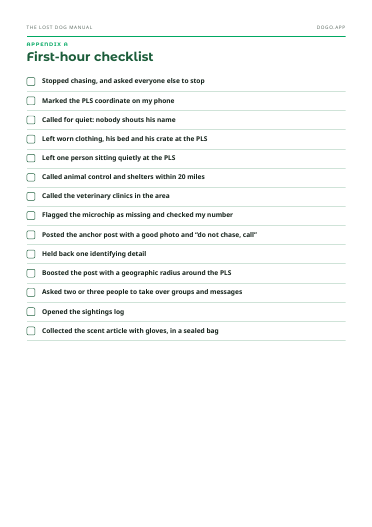
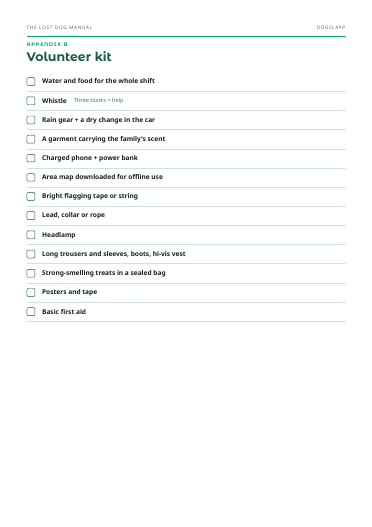
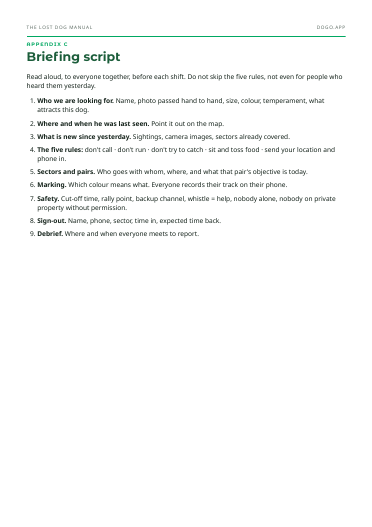
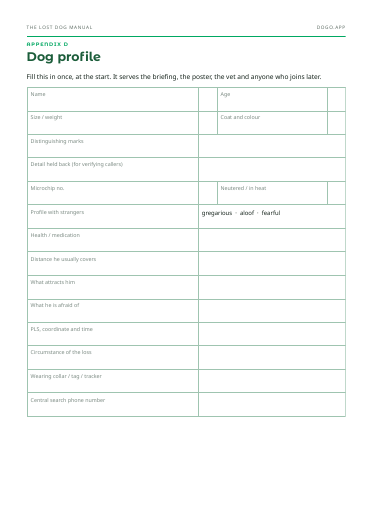
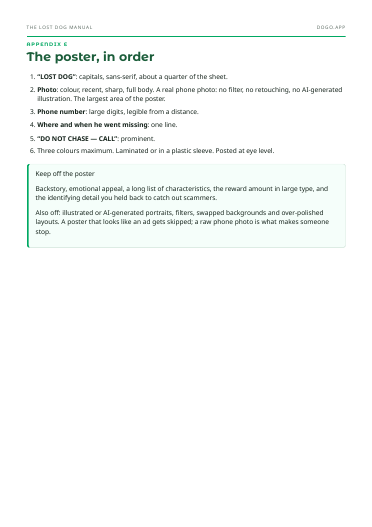
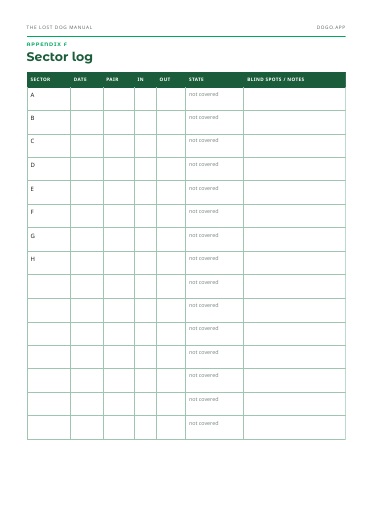
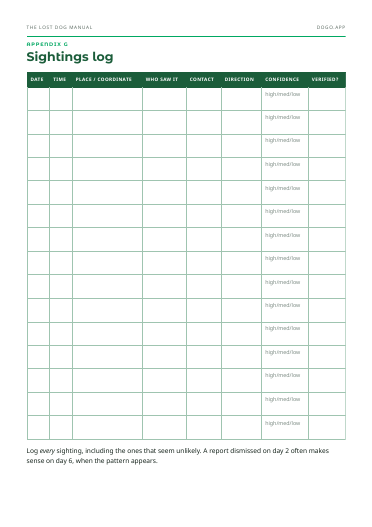
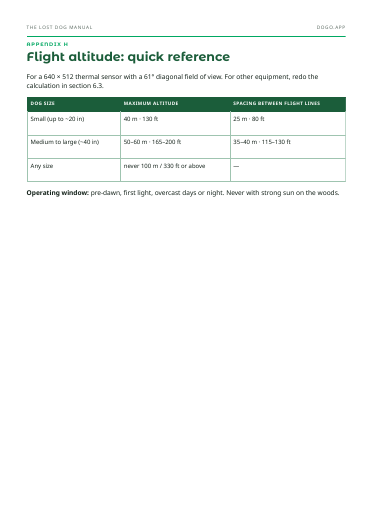
One A4 page. Print it, or open it on a phone and fill it in later.
Download PDFAppendix AFirst-hour checklist
- Stopped chasing, and asked everyone else to stop
- Marked the PLS coordinate on my phone
- Called for quiet — nobody shouts his name
- Left worn clothing, his bed and his crate at the PLS
- Left one person sitting quietly at the PLS
- Called animal control and shelters within 20 miles
- Called the veterinary clinics in the area
- Flagged the microchip as missing and checked my number
- Posted the anchor post with a good photo and “do not chase — call”
- Held back one identifying detail
- Boosted the post with a geographic radius around the PLS
- Asked two or three people to take over groups and messages
- Opened the sightings log
- Collected the scent article with gloves, in a sealed bag
Appendix BVolunteer kit
- Water and food for the whole shift
- WhistleThree blasts = help
- Rain gear + a dry change in the car
- A garment carrying the family's scent
- Charged phone + power bank
- Area map downloaded for offline use
- Bright flagging tape or string
- Lead, collar or rope
- Headlamp
- Long trousers and sleeves, boots, hi-vis vest
- Strong-smelling treats in a sealed bag
- Posters and tape
- Basic first aid
Appendix CBriefing script
Read aloud, to everyone together, before each shift. Do not skip the five rules — not even for people who heard them yesterday.
- Who we are looking for. Name, photo passed hand to hand, size, colour, temperament, what attracts this dog.
- Where and when he was last seen. Point it out on the map.
- What is new since yesterday. Sightings, camera images, sectors already covered.
- The five rules: don't call · don't run · don't try to catch · sit and toss food · send your location and phone in.
- Sectors and pairs. Who goes with whom, where, and what that pair's objective is today.
- Marking. Which colour means what. Everyone records their track on their phone.
- Safety. Cut-off time, rally point, backup channel, whistle = help, nobody alone, nobody on private property without permission.
- Sign-out. Name, phone, sector, time in, expected time back.
- Debrief. Where and when everyone meets to report.
Appendix DDog profile
Fill this in once, at the start. It serves the briefing, the poster, the vet and anyone who joins later.
| Name | Age | ||
| Size / weight | Coat and colour | ||
| Distinguishing marks | |||
| Detail held back (for verifying callers) | |||
| Microchip no. | Neutered / in heat | ||
| Profile with strangers | gregarious · aloof · fearful | ||
| Health / medication | |||
| Distance he usually covers | |||
| What attracts him | |||
| What he is afraid of | |||
| PLS — coordinate and time | |||
| Circumstance of the loss | |||
| Wearing collar / tag / tracker | |||
| Central search phone number | |||
Appendix EThe poster, in order
- “LOST DOG” — capitals, sans-serif, about a quarter of the sheet.
- Photo — colour, recent, sharp, full body. A real phone photo: no filter, no retouching, no AI-generated illustration. The largest area of the poster.
- Phone number — large digits, legible from a distance.
- Where and when he went missing — one line.
- “DO NOT CHASE — CALL” — prominent.
- Three colours maximum. Laminated or in a plastic sleeve. Posted at eye level.
Keep off the poster
Backstory, emotional appeal, a long list of characteristics, the reward amount in large type — and the identifying detail you held back to catch out scammers.
Also off: illustrated or AI-generated portraits, filters, swapped backgrounds and over-polished layouts. A poster that looks like an ad gets skipped; a raw phone photo is what makes someone stop.
Appendix FSector log
| Sector | Date | Pair | In | Out | State | Blind spots / notes |
|---|---|---|---|---|---|---|
| A | not covered | |||||
| B | not covered | |||||
| C | not covered | |||||
| D | not covered | |||||
| E | not covered | |||||
| F | not covered | |||||
| G | not covered | |||||
| H | not covered |
Appendix GSightings log
| Date | Time | Place / coordinate | Who saw it | Contact | Direction | Confidence | Verified? |
|---|---|---|---|---|---|---|---|
| high/med/low | |||||||
| high/med/low | |||||||
| high/med/low | |||||||
| high/med/low |
Log every sighting, including the ones that seem unlikely. A report dismissed on day 2 often makes sense on day 6, when the pattern appears.
Appendix HFlight altitude — quick reference
For a 640 × 512 thermal sensor with a 61° diagonal field of view. For other equipment, redo the calculation in section 6.3.
| Dog size | Maximum altitude | Spacing between flight lines |
|---|---|---|
| Small (up to ~20 in) | 40 m · 130 ft | 25 m · 80 ft |
| Medium to large (~40 in) | 50–60 m · 165–200 ft | 35–40 m · 115–130 ft |
| Any size | never 100 m / 330 ft or above | — |
Operating window: pre-dawn, first light, overcast days or night. Never with strong sun on the woods.
SourcesWhere this comes from
The techniques in this manual combine ground search-and-rescue practice, the literature on lost-animal recovery, and field experience from thermal drone pilots on real searches. The canine behaviour side — profiles, triggers, calming signals, approach and recovery after a reunion — was guided by the trainers and veterinarians specialising in animal behaviour who develop Dogo's programmes. Part 11, on grief, draws on pet-loss counselling literature and on Pauline Boss's work on ambiguous loss.
- Missing Animal Response Network — Lost Dog Behavior Behavioural profiles, distances travelled, and why you should not call a lost dog.
missinganimalresponse.com/lost-dog-behavior - Missing Animal Response Network — Lure, don't chase / When to set a trap Calming signals and the criteria for setting a trap.
missinganimalresponse.com/lost-pet-tips - The Retrievers — Humane Capture of Skittish Dogs Humane capture of fearful dogs.
theretrievers.org/humane-capture-of-skittish-dogs - Buddha Dog Rescue & Recovery — Feeding Stations Setting up and running feeding stations.
buddhadogrescueandrecovery.com - Lost Dogs of America — Trail Cameras Positioning trail cameras to monitor a lost dog.
lostdogsofamerica.org - American Kennel Club — First 48 Hours First-hours protocol, shelters and microchip.
akc.org/expert-advice/health/dog-lost-48-hours - Six Step Process in SAR — Tayside & Central Scotland SAR The six-step cycle used in Part 4.
tcsr.org.uk — six-step-process-in-sar - Critical Separation and Probability of Detection for Grid Searching Technical basis for volunteer line spacing.
tcsr.org.uk — critical separation and POD - Sweep Width Estimation for Ground Search and Rescue — NSARC / USCG The collapse of effective sweep width at night and in dense vegetation.
dco.uscg.mil — sweep width estimation - Search Management Action Plan — SARBC Sectorisation, containment, hasty search and command post.
sarbc.org — SearchMgmtActionPlan - Search and Rescue Services — Thermal Drone Use for Lost Animals Thermal windows and altitude limits.
searchandrescueservices.com.au - Lost Pet Research — How to Boost a Facebook Post for a Lost Pet Geo-targeted boosting.
lostpetresearch.com - FBI and AARP — lost pet scam alerts Warning signs and how to verify a caller.
fbi.gov — beware of lost pet scams - Lost Dog Tracking Network — Preparing and Handling Scent Articles Collecting and preserving the scent article.
lostdogtrackingnetworksurrey.co.uk - PetMD — Hypothermia in Dogs Body temperature ranges and the risk of a wet coat.
petmd.com/dog/conditions/cardiovascular/dog-hypothermia - Mountaineering Scotland — Lost Dogs Lost dog behaviour in mountain terrain.
mountaineering.scot - PetRadar — Creating a Lost Dog Poster Designing an effective poster.
petradar.org - TODAY — Pet Loss Grief: Experts Weigh In Disenfranchised grief and the weight of guilt, with pet-loss counsellor Beth Bigler.
today.com — processing pet loss grief - Dr. Lucy Hone — The Disenfranchised Grief of Pet Loss Why the lack of social validation stalls grieving.
drlucyhone.com/blog/pet-loss-and-disenfranchised-grief - PetMD — Deceased Pet Care: Burial and Cremation Options Timeframes, vets holding the body, private vs communal cremation, burial rules.
petmd.com/dog/care/deceased-pet-care - Funeral.com — Necropsy for Pets: What It Can and Can't Answer What a veterinary necropsy does and does not resolve.
funeral.com — necropsy for pets - Pauline Boss — Ambiguous Loss The concept of ambiguous loss, frozen grief, and the critique of “closure”.
onbeing.org — navigating loss without closure - UC Davis School of Veterinary Medicine — Helping Children Understand Pet Loss Honest language with children and why to avoid euphemisms.
vetmed.ucdavis.edu — helping children understand pet loss - AACAP — When a Pet Dies Child-psychiatry guidance by developmental stage; do not say the animal ran away.
aacap.org — when a pet dies - American Kennel Club — Do Dogs Grieve Other Dogs? Behaviour changes in the surviving dog and how long they last.
akc.org — do dogs grieve other dogs - VCA Animal Hospitals — Helping Your Grieving Pet Practical management of the dog who stayed: routine, company, when to see the vet.
vcahospitals.com — helping your grieving pet - Tufts and Cornell — free pet-loss support lines Examples of services run by veterinary schools.
vet.tufts.edu/pet-loss-support-helpline - American Kennel Club — How to Know When You're Ready for Another Dog No universal timetable, and the test of looking forward rather than back.
akc.org — ready for another dog - Lap of Love — Factors to Consider When Adopting a New Pet After a Loss Comparison with the previous animal, household agreement, and fostering as a middle path.
lapoflove.com/blog/pet-loss-support
Part ten
If the days go by
Dogs are found after weeks and even months — it happens often, and it is a good reason not to dismantle the operation early. What usually unlocks a long search is rarely more people: it is changing something about the method.
10.1Escalating in six moves
In shortSix moves: blind spots, widen the radius, distant towns, remote team, cameras and water sources. And revise the hypothesis, not just the effort.
- Go to the blind spots
Overlay the recorded tracks and look at the holes: the marsh nobody wanted to cross, the bank, the thorn thicket, the locked property. Those are precisely the most attractive places for a hidden dog, and precisely the ones volunteers avoided.
- Widen the radius
If the initial radius has been exhausted with no sign, it was smaller than it needed to be — something you can only know afterwards. Redraw the circle at double the reach, keeping the slice and priority logic.
- Take the posters further out
Neighbouring towns and districts, with requests for announcements at services and on local radio. The more days pass, the higher the chance the dog is already in another municipality — and that someone has taken him in.
- Build the remote team
Trusted people, away from the operation, sweeping lost-and-found groups, posting daily and checking “found dog” and rehoming ads. A lot of lost dogs reappear as dogs being given away.
- Spread cameras
At the funnels, at water sources and at the stations. A camera works 24 hours a day without tiring, without frightening anything and at no cost per hour — the best investment in a long search.
- Watch the water
Springs, creeks, ponds and troughs, at the hours he used to drink at home. He may find food or go without; water he needs, every day, in the same kind of place.
Revise the hypothesis, not just the effort
If the priority sector has been well covered and nothing turned up, it is worth considering that your main hypothesis was probably wrong — and pushing on with it is the most common mistake in long searches. Sit the team down, re-interview the original witnesses and redo the Size-up (section 4.2) from scratch, with everything you have learned since.
10.2The marathon
In shortShifts and rest. Keep a minimum running indefinitely: one stocked station, one active camera and one post a day.
Nobody sustains two weeks at first-day pace, and an exhausted team searches badly. Treat fatigue as an operational risk, because it is.
- Shifts. Half the team rests while the other half works. No exception for the owner.
- You need to sleep. Night is not the time to sweep woodland — it is the time to rest, train the dogs and plan the next day.
- Hand over command when you need to. It is normal, and right, for someone from outside to take over coordination when the family no longer can. That is not giving up.
- Keep a minimum running indefinitely: one stocked station, one active camera and one post a day. It is cheap, sustainable, and it buys the weeks in which most late reunions happen.
10.3When he comes back
In shortVet even if he looks fine, gradual refeeding, and treat the cause of the escape so it does not repeat.
The vet first
Even if he looks fine.15 After days outside, the exam looks for dehydration, hypothermia, wounds and abscesses, damaged paw pads, ticks and fleas, intestinal parasites, foreign bodies and significant weight loss.
- Gradual rehydration and refeeding, under guidance. Unlimited food after a long fast is dangerous.
- If he is hypothermic, warm him gradually — blankets and a warm room, never direct heat on the skin.
Then the behaviour
He may come back different: jumpy, clingy, wary of strangers, reactive to noise, or anxious when left alone. That is expected and, in most cases, temporary.
- Predictable routine and a calm environment in the first days. No welcome party with visitors.
- Let him seek contact rather than forcing it.
- Resume bonding and recall work with positive reinforcement, indoors and safely, before any off-lead walk.
- Treat the cause of the escape. If he bolted from fireworks, thunder or engine noise, that is treatable — and untreated, it repeats. Desensitisation work, done outside the risk season, is what prevents a second time.
- If the fear persists for weeks, seek professional help with canine behaviour.
In the Dogo app
For the recovery phase, the separation anxiety, noise fear and confidence-building programmes in Dogo give you a short daily routine, with video, to do at home without overloading the dog. And if you want to talk to a person, Dogo has trainers who follow cases like this — including the human side, which usually needs as much care as the dog's.
10.4So it never happens again
In shortLayered ID, up-to-date photos, an emergency recall and desensitisation done outside the risk season.
- Layered identification: a physical tag with a phone number, a microchip with current registration, and a tracker suited to the environments you actually spend time in.
- Up-to-date photos every few months: full body from both sides, front on, and close-ups of distinguishing marks. It is the poster photo you hope never to need.
- An emergency recall — a different word from your everyday recall, trained with the best reward in the house and never used for anything unpleasant.
- A travel and camping protocol: a long line anywhere unfamiliar, never off-lead on a first visit to a place, and a tracker-and-battery check before leaving.
- Desensitisation to fireworks and storms done in advance, outside the season — the single largest cause of escapes.
AirTag or GPS: which tracker to buy
An AirTag (or an equivalent Bluetooth tag) has no GPS: it is only located when someone else's phone happens to pass nearby and relays its position. That works well in a city, but goes silent in woods, farmland, or a back road — exactly where a lost dog tends to end up. Collars with GPS and a cellular chip, such as Fi and Tractive, send a real-time position over the phone network, work outside the city wherever there is coverage, and usually include an automatic escape alert. The full comparison, covering every tracking technology, is in Part 6.1.
If your dog spends time in rural areas, on trails, or already has an escape history, a GPS collar is the investment that most reduces the risk of a next search. An AirTag can still serve as a cheap extra layer for everyday city life — it just does not replace GPS outside it.
For your situationStart with the Bluetooth tag — that is the right fit for your case.
For your situationPrioritise the GPS collar with a cellular SIM — that is the right fit for your case.
In the Dogo app
Almost everything on this list is ordinary training, done before it is needed. In Dogo, the Perfect Recall programme covers the emergency recall, and there are specific tracks for noise fear and safe walking. Twenty minutes a day, in quiet weeks, is what prevents the week described in this book.
Part eleven
Living with grief
Before you start
If your dog is still missing and you are in the middle of the search, this part is not for now. It was placed at the end deliberately, and it will still be here if it is ever needed. Go back to Part 10 and carry on.
This part exists because not every search ends with the dog at home. It was written with guidance from specialists in pet-loss grief, and it covers two different situations: when there is an answer, and when one never comes.
11.1A grief almost nobody validates
In shortThe pain is real even if nobody around you treats it as a loss. Hiding what you feel is exactly what stalls grief.
The first thing that gets in the way for someone who loses a dog is not the pain: it is other people's reaction to it. Specialists call this disenfranchised grief — a real loss that the surrounding culture does not treat as one.18
As pet-loss counsellor Beth Bigler observes, when someone loses a dog there is no leave from work, no funeral, no meal train, nobody at the door.18 People say “it was just a dog”, or, meaning well, “you can get another one”. The result is that the grieving person learns to hide what they feel — and hiding is precisely what stalls grief.19
If it helps at all
What you feel is proportional to the bond, not to what other people think it should be worth. You are not overreacting. You do not have to explain yourself to people who do not understand — look for the ones who do, and they exist.
11.2The guilt
In shortGuilt weighs more in pet loss than in other griefs. You decided with the information you had, not the information you have now.
In pet-loss grief, guilt weighs more than in other kinds of loss.18 And with a dog who went missing, it has a precise address: the gate that was left open, the lead I unclipped, the fright I did not foresee, the five minutes I was not watching.
This is worth saying plainly: an accident is an accident. Nobody who loves a dog loses him on purpose, and no careful person can foresee every scenario all of the time. You made decisions with the information you had at that moment — not with the information you have now, after reading an entire book about it.
Guilt usually disguises itself as analysis: replaying the scene looking for the instant when everything could have gone differently. That is normal and it passes, but if it is occupying your nights, it is a sign the conversation needs someone else in it — a professional, a group, someone who has been through it.
And there is the guilt of whoever organised the search: I should have widened the radius sooner, I chose the wrong slice. Every search decision is made under uncertainty. Choosing the most probable hypothesis and being wrong is not negligence — it is what working with probability means.
11.3If he is found dead
In shortSeeing or not seeing the body: both are normal, and neither is required. What is time-sensitive is the body and, if relevant, the necropsy.
Nothing prepares anyone for that moment, and there is no right way through it. What does exist is a handful of practical decisions that arrive far too quickly, and it is better to know about them beforehand than to discover them in shock.
To see or not to see
For some people, seeing the body confirms the reality and helps them close; for others, the image stays and hurts for a long time. Both reactions are normal and neither is an obligation. If you are unsure, ask someone you trust to look first and describe it — then decide. If identification is necessary, ask whether it can be done by photo, by microchip or by a specific marking.
The body
- Call a vet. Most clinics will hold the body for 24 to 48 hours while the family decides, often at no charge.20
- Time matters: in heat, decomposition is quick; aim to resolve within 12 to 24 hours. In cold weather there is a little more margin.20
- If you have to transport him, use a blanket or a box and ask someone for help — do not do it alone if you can avoid it.
Knowing what happened
A veterinary necropsy exists, and it answers some questions — not always all of them.21 It is worth considering if there is any suspicion of poisoning, of a crime, or of something that could affect other animals in the area. If the answer would not change anything and the question is not consuming you, it is also legitimate not to want to know. It is a decision that has to be made quickly, but it does not have to be made alone.
Cremation or burial
- Private cremation returns the ashes; communal does not. Ask the vet which service they use and confirm which of the two is being arranged — that confusion is common and cannot be undone.20
- Burial on private property depends on local law: there are rules on depth and distance from water sources and wells, and burial on public land is usually prohibited. Check first.20
Keeping something
Many people regret keeping nothing, and almost nobody regrets keeping something. The collar, the tag, a lock of hair, a paw print in clay, the toy. You do not have to look at any of it now — you just do not have to decide about it today.
Do not decide in the first impact
In the first hours everything feels urgent. Almost nothing is. Ask someone to take over the phone calls, and postpone whatever can be postponed. The only genuinely time-sensitive decisions are what to do with the body and, if relevant, the necropsy.
11.4When an answer never comes
In shortAmbiguous loss: grief freezes because the answer never arrives. Swinging between hope and despair in one day is expected, not weakness.
There is a loss even harder to move through than a confirmed death: the one where you never know. The researcher Pauline Boss gave it a name — ambiguous loss: the loss that resists any resolution, because the information never arrives.22
Boss describes what happens: grief freezes, because the brain keeps searching for an answer that may never come.22 In practice, that means swinging between hope and despair several times in the same day, feeling longing and anger together, thinking you are improving and then coming apart at a bark in the street. That is not instability and it is not weakness. It is the expected response to a situation with no shape.
And there is a compounding problem: there are no rituals for this. Nobody knows what to say, there is no date, no ceremony, no moment when the people around you understand that it is over — because it is not over.
The idea of “closure” gets in the way
Boss is blunt about this: the notion of closure, of turning the page and finishing, is a myth that leads us somewhere unhelpful.22 The goal is not to stop missing him. It is to be able to live with an open question — which is possible, and which a great many people do.
When to stop searching
There is no right day, and nobody outside has the standing to name it. What usually works better than stopping is reducing: dismantling the intensive operation, which is not sustainable, and keeping the passive layer — an occasional post, the microchip flagged, contact with the shelters, a camera if it still makes sense. That lets you go back to working, sleeping and eating without it feeling like abandonment.
If at some point you decide to stop altogether, that is not abandonment either. It is recognising a limit — and you did what it was possible to do.
Making the ritual that does not exist
Because there is no ceremony for this kind of loss, many people invent their own. Boss notes that one of the most powerful ways of making meaning out of ambiguous loss is precisely the symbolic gesture: writing, planting something, making an album, marking a date, giving in his name.22 It is not pretending there was an ending. It is giving the missing somewhere to live.
11.5Telling children
In shortUse the word “died”. Never say he ran away, if he died. And do not replace him quickly.
Guidance from veterinary schools and child psychiatry is consistent, and it runs against most adults' instincts:
- Use the words “died” and “death”. Euphemisms confuse and erode trust. Saying he “went to sleep” can terrify a small child at bedtime.23
- Do not say he ran away if he died. The child starts wondering why he did not love them enough to stay — and learns to distrust what they are told.24
- Tell them early, somewhere quiet, with time for questions and for saying goodbye.23
- Match the developmental stage, not the age on paper. Very young children respond mainly to the emotional state of the adults around them; between two and five, they miss the playmate.24
- Do not replace him quickly. Bringing another dog home straight away teaches that the last one was replaceable.24
- Let the child see you sad. That is how they learn sadness is acceptable and can be talked about.
For a dog who went missing and was never found, honesty is still the way, with the uncertainty included: “we looked very hard, we couldn't find him, and we don't know what happened to him.” Children cope better with an incomplete truth than with an explanation that later turns out to be false.
11.6The dog who stayed
In short86% of owners report behaviour changes in the surviving dog. Stable routine helps most; the peak passes in a few weeks.
Dogs feel the absence of a companion. In a survey of owners, 86% reported behavioural changes in the surviving dog after the other one died: more attention-seeking, less appetite, less play, over several months.25
Common signs: listlessness, searching the house, lying in the other dog's spot, eating less, sleeping more or less, vocalising more, sticking to you. The most intense phase is usually the first two weeks to the first month, and things generally settle between two and six months.25
- Keep the routine. Stable feeding, walking and sleeping times are what most reassures a grieving dog.26
- More company and activity, without forcing. If he does not want to play today, that is fine.
- Watch for accidental reinforcement: if every display of sadness produces a cuddle, some dogs learn the pattern. Offer attention in the calm moments too.
- If he stops eating for more than a day or two, or if something looks physical rather than emotional, see the vet — grief and illness look alike.
- Do not bring another dog in to “fix” his sadness. It may help later; it rarely helps now.
If your dog took part in the search, he was looking too. It is worth giving him a proper ending: walks in the usual places, presence, calm.
11.7The volunteers
In shortTell everyone, thank them concretely, and close the operation: collect tape, cameras, stations and posters.
The people who searched with you lost something too — and they usually have no idea what to do with it. Two things help both sides:
- Tell everyone, however hard it is. One short message to the group, with no obligation to reply. Leaving the group without news keeps people searching and keeps them asking.
- Thank them concretely. Say what each front achieved. Someone who swept a sector in the cold needs to know it mattered, whatever the outcome.
- Close the operation: collect the tape from the woods, take down the cameras and stations, remove the posters. It is tedious work and it helps more than it seems — for you and for whoever comes next.
- Accept help from anyone who offers. Many people will want to do something and will not know what; giving them a task is a gift to both of you.
11.8When to look for help
In shortThe signs that grief is not moving on its own — and what to do about them.
Grief is not an illness and does not need treatment in order to exist. But there are signs that it is not moving on its own:
- Not being able to go back to working, eating or sleeping after weeks.
- Guilt that fills the whole day and does not let up.
- Isolation, or hiding what you feel because nobody validates it.
- An increase in alcohol or other substances.
- Any thought of hurting yourself — in that case, get help today, not later.
Therapists treat pet loss as legitimate grief; you do not have to justify the subject. There are also dedicated support groups, in person and online, and veterinary schools that run free pet-loss support lines — those at Tufts and Cornell, in the United States, are well-known examples.27 Look for what exists where you live; a local vet or shelter is usually the fastest way to find it.
In the Dogo app
Dogo's programmes are developed with trainers and veterinarians specialising in animal behaviour, and part of that team follows families through situations like this — both the care of the dog who stayed and the human side, which usually needs as much attention.
11.9When to get another dog
In shortThere is no timetable. The test is direction: are you looking forward, or trying to fill a hole?
There is no timetable. Some people are ready in weeks, some need months or years, and some never get another dog.28 All of those answers are legitimate, and none of them measures what existed.
What the specialists offer is not a calendar — it is a test of direction.
The question that helps you decide
Are you looking forward or backward? Adopting because you have started to imagine what kind of dog would suit your house now is different from adopting to fill a hole.28 The first is openness. The second usually turns into resentment — towards the new dog, who is not at fault for not being the other one.
And it is worth saying, because almost everyone needs to hear it: imagining a future with another dog does not mean you have stopped missing him, or loved him any less. Both things fit together.
Signs it might be time
- You can remember him without the memory taking down your day.
- You catch yourself thinking about what kind of dog would suit your current routine — not about how to get the old one back.
- The idea of caring for another brings curiosity rather than obligation.
- You have the reserves for his bad days. A new dog, and a puppy especially, is real work.
Signs it might not be
- The main motivation is to stop feeling the absence.
- You are looking for the same dog: same breed, same colour, same name.
- Someone in the household does not want to, or was not consulted. Bringing an animal home before everyone is ready causes hurt and damages the bond with the one who arrives.29
- You are adopting for a child, hoping to fix their sadness.
Do not look for a copy
Vets and behaviour specialists are consistent on this: comparing constantly — “the other one was calmer”, “the other one understood me” — usually signals grief that has not been worked through, and it obstructs the formation of a real bond.29 Every dog has his own personality, pace and way of communicating. The new one will not fill the shape of the old one, and should not. On reusing the name: it tends to weigh more than people expect, both on you and on the people around you.
The dog who stayed also gets a vote
A grieving dog does not necessarily want new company now. Wait until he is eating, sleeping and walking normally again before bringing anyone home, and make the introduction slowly, on neutral ground.
A middle path
If you are unsure, consider fostering before adopting.29 It is a smaller commitment, concrete help to an animal who needs it, and it answers in practice a question you cannot answer in theory. If it works, you adopt — or you keep fostering, which is also a good answer.
If your dog was never found
Here a specific guilt turns up: adopting feels like betrayal, or like giving up. It is neither. You can keep the microchip flagged as missing, keep in touch with the shelters and keep posting occasionally — and still have another dog asleep in the living room. Searching and living are not mutually exclusive.
Where to adopt from
It is worth remembering where a good share of the reunions in this book come from: shelters, fosterers and rescue groups who take in found animals. If you decide to adopt, that is a good place to start looking — and a way of closing the circle.
One last thing. Searching well raises the odds — that is what this book is for — but it does not make them certainties. If your search did not end the way you wanted, that does not mean it was done badly, or that you failed him. You looked for him. He was very loved. Both of those remain true.
Credits
- Author
- Dogo App
- Curation and review
- Giovanna Mundstock · Justina Samoškaitė · Gediminas Gerulaitis · Jeny Paik
- Technical guidance
thermal drone and GSD - Gediminas Gerulaitis, search-and-rescue pilot, Lithuania
- Canine behaviour
- Trainers and veterinarians specialising in animal behaviour at Dogo
- Search method
- Adapted from the six-step ground search-and-rescue cycle (TCSR, SARBC) for the canine context